

UNMEASURED
UNMEASURED er et EU forskningsprojekt ledet af Nina Isabella Moeller på SDU. Projektet varer 36 måneder fra april 2026 til marts 2029 med et samlet budget på ca. 17.2 millioner DKK.
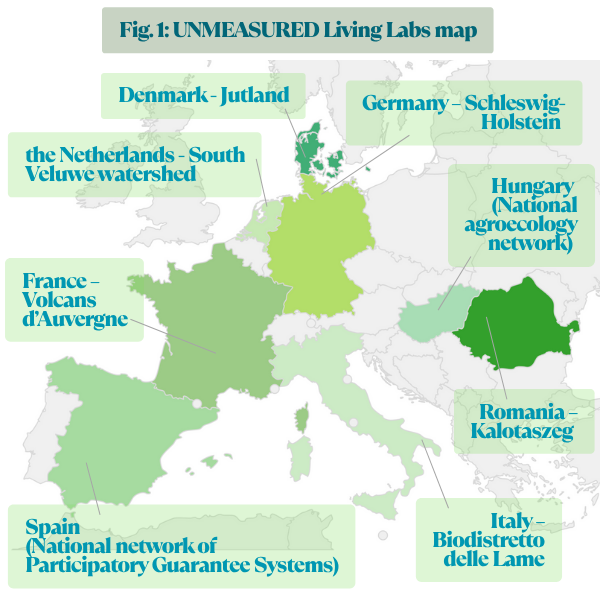
UNMEASURED er støttet med midler fra EUs Agroecology Partnership og Grønt Udviklings- og Demonstrationsprogram (GUDP) under Ministeriet for Fødevarer, Landbrug og Fiskeri (1.82m EUR / 13.6m DKK) og er baseret på living labs, med ti partnere i otte lande:
UNMEASURED handler om alt det, som er usynliggjort i det metriske, kvantitative, reduktionistiske paradigme og som er vigtigt, måske essentielt i landbrugets og samfundets grønne omstilling.
Vi kigger kritisk på kvalitative aspekter, sociale, kulturelle, spirituelle og andre værdibærende dimensioner; ‘varm data’; og andet som ikke let kan måles og vejes; samt alt det, der egentlig holder et system sammen og som giver fodfæste til forandringens kollektive handlekraft.
- Syddansk Universitet (SDU), Danmark
- Cordoba Universitet, Spanien
- Wageningen Universitet, Nederlandene
- Thuenen Institut, Tyskland
- RESEAU INTERNATIONAL URGENCI, Frankrig
- ALPA – Land for Life, Rumænien
- INRAE, Frankrig
- CIHEAM IAMB, Italien
- Frie Bønder – Levende Land, Danmark
- Hungarian Agroecology Network Association, Ungarn
Vil du vide mere eller måske deltage, give input eller konstruktiv kritik, så skriv til Nina.
~ see also the English language website on: https://unmeasured.agroecology.world ~
UNMEASURED vil udvikle bedre måder at arbejde med det, som ofte falder uden for standardmålinger, simpel kvantificering og reduktionistiske indikatorer. Unmeasured tager således udgangspunkt i, at vigtige sider af agroøkologiske omstillinger ikke altid kan reduceres til tal, indikatorer og simple sammenligninger. Projektet vil derfor styrke eksisterende vurderingsrammer ved at integrere kvalitative, deltagelserbaserede og kontekstfølsomme metoder, så også sociale, kulturelle og etiske dimensioner kan blive synlige og brugbare i praksis. Fx:
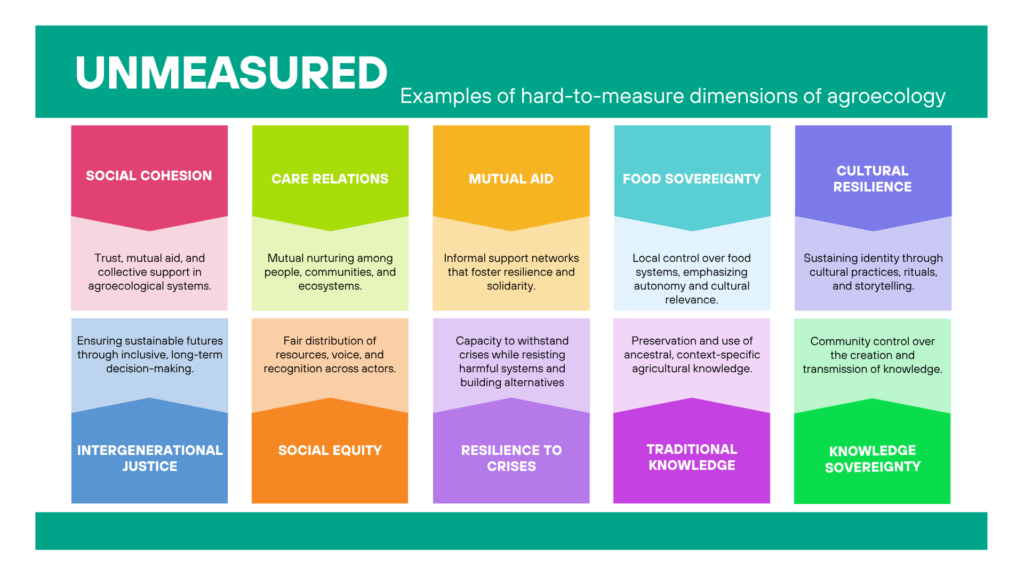
UNMEASURED fokuserer på det, der ofte er svært at måle, men som er afgørende for agroøkologisk omstilling. Det gælder blandt andet social sammenhængskraft, omsorgsrelationer, gensidig hjælp, fødevaresuverænitet, videnssuverænitet, kulturel resiliens, traditionel viden, intergenerationel retfærdighed, social retfærdighed og robusthed i kriser.
I stedet for at afvise kvantitative mål vil UNMEASURED arbejde for, at de suppleres af metoder, der bedre kan indfange det, som ellers forsvinder i standardiserede evalueringssystemer.
Dermed handler UNMEASURED både om bedre viden og om mere retfærdige beslutningsgrundlag i agroøkologien.
Projektet skal konkret identificere mangler i eksisterende agroøkologiske vurderingsværktøjer, samskabe nye kvalitative indikatorer og deltagerbaserede evalueringsredskaber, udvikle beslutningsstøtte til at synliggøre afvejninger og værdikonflikter, og afprøve det hele i Living Labs i forskellige europæiske sammenhænge.
UNMEASURED bygger dermed bro mellem standardiserede målinger og lokal, erfaringsbaseret viden.
Ambitionen for UNMASURED er at gøre agroøkologisk design og evaluering mere helhedsorienteret, mere demokratisk, epistemisk retfærdig og mere brugbar for både praksis, forskning og politik
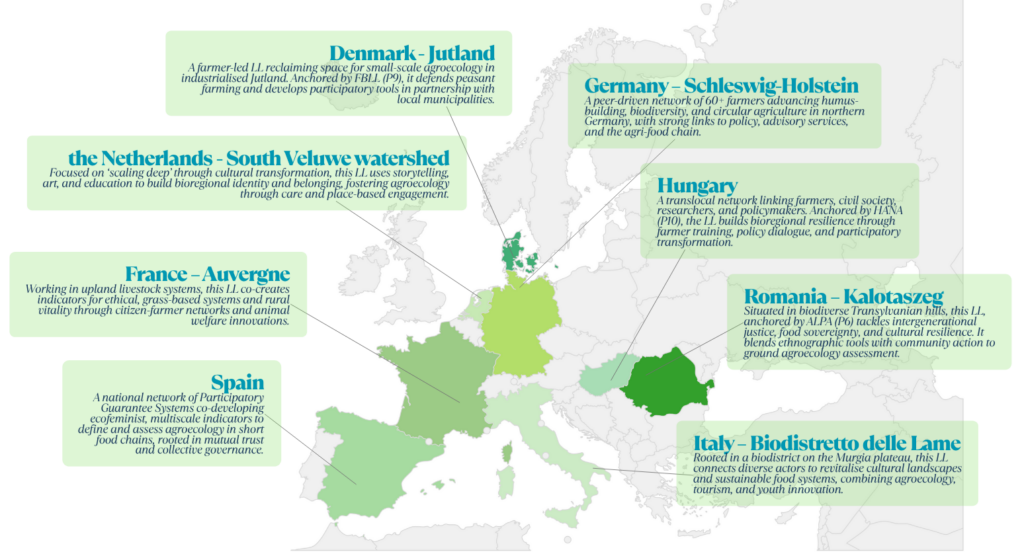
UNMEASURED arbejder med en Living Lab-tilgang, hvor landbrug, civilsamfund, forskere og andre aktører deltager i fælles udvikling og afprøvning af nye værktøjer. Living Labs forstås ikke som passive teststeder, men som medskabende rum for læring, refleksion og territorial forandring. Projektet omfatter Living Labs og beslægtede agroøkologiske netværk i Danmark, Frankrig, Tyskland, Ungarn, Italien, Nederlandene, Rumænien og Spanien. Det giver UNMEASURED et stærkt tværnationalt grundlag for at udvikle metoder, der både er robuste og følsomme over for lokale forskelle.
Et centralt mål i UNMEASURED er at gøre skjulte afvejninger og værdikonflikter i agroøkologiske omstillinger mere synlige. Det gælder for eksempel spændinger mellem økonomiske, sociale, kulturelle og økologiske hensyn. Projektet vil derfor også udvikle beslutningsstøtteværktøjer, dialogformater og læringsredskaber, herunder spilbaserede og participatoriske metoder, som kan bruges af praktikere, rådgivere, forskere og beslutningstagere. På den måde skal UNMEASURED bidrage til mere kontekstfølsomme og retfærdige omstillinger af landbrug og fødevaresystemer.
UNMEASURED er også tænkt som et projekt med stærk offentlig og praktisk relevans. Resultaterne vil blive formidlet her på Agroøkologi @ SDU samt på en dedikeret webside, sociale medier, og gennem workshops, webinarer, træningsmaterialer, policy briefs og en særudgave af Rooted Magazine. Projektet lægger vægt på open science og på at værktøjer og resultater skal være tilgængelige og anvendelige for forskellige brugergrupper.
UNMEASURED handler derfor ikke kun om forskning, men også om at styrke den bredere samfundsmæssige forståelse af agroøkologiens værdier og muligheder.
Arbejdsgangen i UNMEASURED:
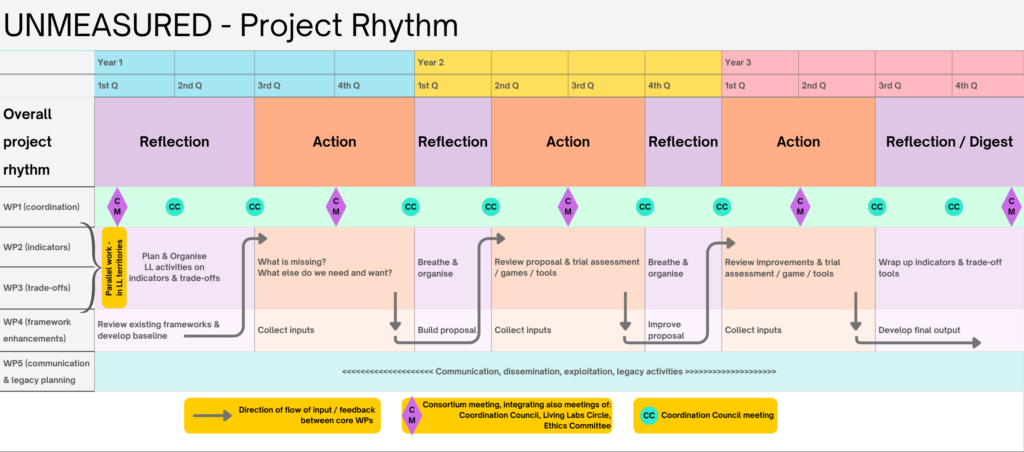
Her er nogle af de kilder og inspirationer, som ligger til grund for UNMEASURED:
- Alrøe, H. F., and E. Noe. 2014. “Second-Order Science of Interdisciplinary Research: A Polyocular Framework for Wicked Problems.” Constructivist Foundations 10: 65–76: https://constructivist.info/10/1/065
- Balogh, L., Réthy, K., and Balázs, B. 2020. Mapping Agroecology in Hungary.
- Balogh, L., Réthy, K., and Tóth, B. 2020. Az agroökológia 10 alapelve.
- Balogh, L., Réthy, K., Strenchock, L., and Szilágyi, A. 2022. Thematic Study of the BIOEAST Thematic Working Group on Sustainable Yields and Agroecology: Socio-Ecological Indicators of Agroecology Systems in the BIOEAST Countries.
- Bateson, Nora. 2016. Small Arcs of Larger Circles: Framing Through Other Patterns. Triarchy Press:
https://www.triarchypress.net/small-arcs.html - Busse, M. et al. 2024. “Conceptualizing and Reflecting Co-Design Processes for the Transformation Towards Insect-Friendly Agricultural Landscapes: Experiences from Transdisciplinary Processes in Three German Landscape Labs.” Journal of Innovation Management 12(3): 273–316:
https://doi.org/10.24840/2183-0606_012.003_0011 - Chen, Y. et al. 2022. “Winegrowers’ Decision-Making: A Pan-European Perspective on Pesticide Use and Inter-Row Management.” Journal of Rural Studies 94: 37–53: https://doi.org/10.1016/j.jrurstud.2022.05.021
- Creswell, John W. 2013. Qualitative Inquiry and Research Design: Choosing Among Five Approaches. 3rd ed. SAGE:
https://books.google.dk/books?id=Ykruxor10cYC - Espeland, Wendy Nelson, and Mitchell L. Stevens. 2008. “A Sociology of Quantification.” European Journal of Sociology 49(3): 401–436: https://doi.org/10.1017/S0003975609000150
- Forum for Food Sovereignty. 2017. Food Sovereignty: Who Can Make Decisions over Our Food? Forum for Food Sovereignty.
- Gava, O. et al. 2025. “Governance Networks for Agroecology Transitions in Rural Europe.” Journal of Rural Studies 114: 103482:
https://doi.org/10.1016/j.jrurstud.2024.103482 - Geertz, Clifford. 1973. The Interpretation of Cultures: Selected Essays. Basic Books:
https://books.google.com/books/about/The_Interpretation_Of_Cultures.html?id=BZ1BmKEHti0C - Haraway, Donna. 1988. “Situated Knowledges: The Science Question in Feminism and the Privilege of Partial Perspective.” Feminist Studies 14(3): 575–599: https://doi.org/10.2307/3178066
- Harding, Sandra. 1991. Whose Science? Whose Knowledge?: Thinking from Women’s Lives. Cornell University Press:
https://www.cornellpress.cornell.edu/book/9780801497469/whose-science-whose-knowledge/ - Kimmerer, Robin Wall. 2013. Braiding Sweetgrass: Indigenous Wisdom, Scientific Knowledge and the Teachings of Plants. Milkweed Editions: https://milkweed.org/book/braiding-sweetgrass
- Latour, Bruno. 2004. Politics of Nature: How to Bring the Sciences into Democracy. Harvard University Press:
https://www.hup.harvard.edu/books/9780674013476 - Lehrmann et al. 2017. A Green and Just Food Policy. Friends of the Earth Denmark and Frie Bønder Levende Land.
- Merry, Sally Engle. 2016. The Seductions of Quantification: Measuring Human Rights, Gender Violence, and Sex Trafficking. University of Chicago Press: https://press.uchicago.edu/ucp/books/book/chicago/S/bo23044232.html
- Mol, Annemarie. 2002. The Body Multiple: Ontology in Medical Practice. Duke University Press:
https://www.dukeupress.edu/The-Body-Multiple/ - Noe, E., and H. F. Alrøe. 2012. “Observing Farming Systems: Insights from Social Systems Theory.” In Farming Systems Research into the 21st Century: The New Dynamic, 387–403:
https://doi.org/10.1007/978-94-007-4503-2_17 - Noe, E., and H. F. Alrøe. 2014. “Sustainable Agriculture Issues Explained by Differentiation and Structural Coupling Using Social Systems Analysis.” Agronomy for Sustainable Development 35: 133–144: https://doi.org/10.1007/s13593-014-0243-4
- Noe, E., and H. F. Alrøe. 2015. “Regulation of Agroecosystems: A Social Systems Analysis of Agroecology and Law.” In Law and Agroecology: A Transdisciplinary Dialogue, 31–45:
https://doi.org/10.1007/978-3-662-46617-9_2 - Peeters, A. et al. 2021. A Green Deal for Implementing Agroecological Systems: Reforming the Common Agricultural Policy of the European Union: https://doi.org/10.3220/LBF1610123299000
- Pixová, M., Spanier, J., and Guerrero Lara, L. 2024. “Building Solidarities and Alliances Between Degrowth and Food Sovereignty Movements.” Journal of Political Ecology 32: https://doi.org/10.2458/jpe.5841
- Porter, Theodore M. 1995. Trust in Numbers: The Pursuit of Objectivity in Science and Public Life. Princeton University Press:
https://press.princeton.edu/books/paperback/9780691208411/trust-in-numbers - Queiroga-Bento, R., and Ujj, A. 2022. Agroecology: Introductory Handbook for Farmers. trAEce.
- Queiroga-Bento, R., Strenchock, L., and Ujj, A. 2022. Agroecological Vocational Training Curriculum Module Summary. trAEce.
- Schwarz, G. et al. 2022. “Exploring Sustainability Implications of Transitions to Agroecology: A Transdisciplinary Perspective.” EuroChoices 21: 37–47: https://doi.org/10.1111/1746-692X.12377
- Scott, James C. 1998. Seeing Like a State: How Certain Schemes to Improve the Human Condition Have Failed. Yale University Press: https://yalebooks.yale.edu/book/9780300078152/seeing-like-a-state/
- Skotte Møller et al. 2019. Money and Political Influence. Global Aktion, Frie Bønder Levende Land, Friends of the Earth Denmark.
- Strenchock, L. 2021. “Germinating Degrowth? On-Farm Adaptation and Survival in Hungarian Alternative Food Networks.” In Food for Degrowth: Perspectives and Practices.
- Strenchock, L., Liegey, V., and Lazanyi, O. 2025. “Reimagining Collaboration: Degrowth Practitioners, Scholars and Activists.” In Routledge Handbook on Degrowth.
- van der Ploeg, J. D. et al. 2019. “The Economic Potential of Agroecology: Empirical Evidence from Europe.” Journal of Rural Studies 71: 46–61: https://doi.org/10.1016/j.jrurstud.2019.09.003
- von Gall, P. et al. “How – and How Much? An Analysis of Major Conflict Lines Regarding the Transformation of German Animal Farming.” German Journal of Agricultural Economics 73(1): https://doi.org/10.52825/gjae.v73i1.1318

This project is part of the programme of the AGROECOLOGY partnership, co-funded by the European Union’s Horizon Europe research and innovation programme under Grant Agreement No. 101132349.