
RESHAPE – fremmedgørelse og fødevarer
RESHAPE er et EU forskningsprojekt, hvor vi kigger på hvordan mennesker og fødevaresystemer kan genforbindes igennem systemer med fokus på dyrevelfærd, hvor landskabspleje, klimavenlighed, ernæringsværdi optimeres; og glæden ved at spise således styrkes.
Projektets varighed er 36 måneder fra april 2026 til marts 2029 med syv partnere i seks lande, det er støttet af EUs FutureFoodS Partnership (European partnership for a sustainable Future of Food Systems) og Demonstrationsprogram (GUDP) under Ministeriet for Fødevarer, Landbrug og Fiskeri med et samlet budget på ca. 14m DKK

The project RESHAPE is co-funded by GUDP and the European Union’s Horizon Europe research and innovation programme via FutureFoodS, the European Partnership for a Sustainable Future of Food Systems, co-funded under Grant Agreement No. 101136361.

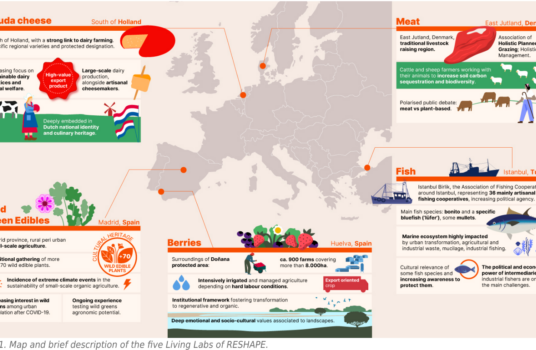
I det danske living lab arbejder SDU tæt sammen med Foreningen for Holistisk Planlagt Afgræsning (HOPLA) og Videnscenter for Holistisk Management med fokus på kvæg som værdifulde allierede partnere i naturpleje og naturnærende landskabning.
I de systemer vi evaluerer og formidler ser og forstår vi læder, knogler, oksekød og andre nyttige dele af koen som et udtryk for landskabets taknemmelighed og ikke et primært produkt.
Arbejder du med kvæg i naturnære systemer og har lyst til at dele viden, erfaring og være med til at formidle og forklare at koen i stalden, der spiser soja fra regnskoven intet har med den rotationsafgræssende ko, der altid går ude, at gøre, så skriv til os!
Som del af vores kontinuerlige eksperimentation med metoden ‘living lab’ vil vi finde synergier med UNMEASURED og LIFT samt selvfølgelig partnerne i RESHAPE konsortiet:
- Centro Superior de Investigaciones Científicas – Estación Biológica de Doñana
- Vrije Universiteit Amsterdam
- WU Vienna University of Economics and Business
- University of Córdoba – Instituto de Sociología y Estudios Campesinos
- Syddansk Universitet
- Bogazici University
RESHAPEs udgangspunkt:
Urbanisering, specialisering og industrialiserede, globalt sammenkoblede fødevaresystemer har skabt større afstand mellem mennesker og den mad, de spiser. Når forbindelsen mellem mennesker, produktion, landskab og værdikæder svækkes, bliver det også sværere at skabe bæredygtige, retfærdige og robuste fødevaresystemer. RESHAPE vil derfor undersøge, hvordan denne afstand kan mindskes gennem nye former for samarbejde, viden, deltagelse og værdiforandring.
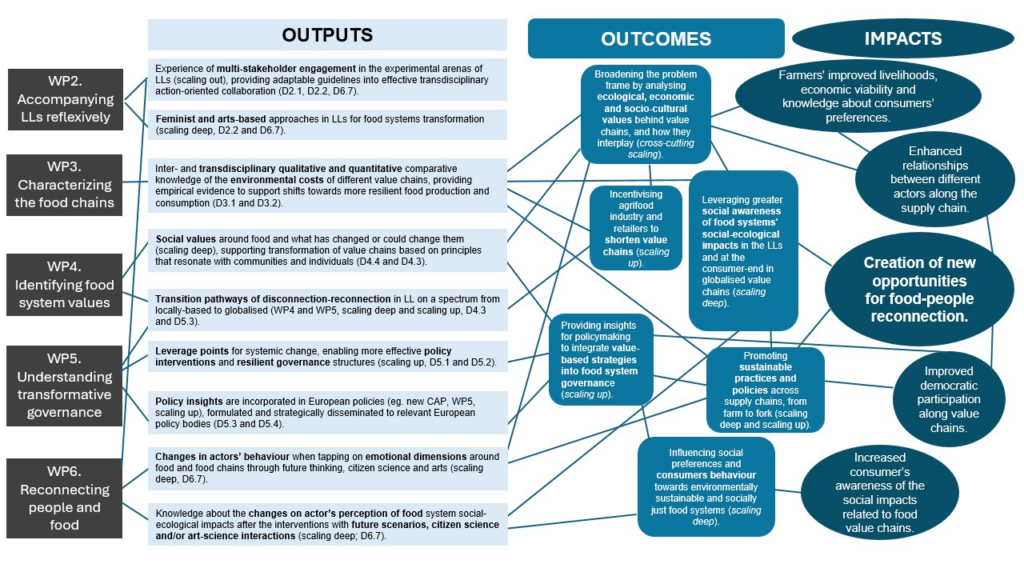
RESHAPE skal munde ud i ny viden, nye værktøjer og nye politiske og praktiske handlemuligheder. Projektet vil levere indsigt i miljømæssige hotspots i værdikæder, sociale og kulturelle værdier omkring mad, forskellige styringsformer og muligheder for at skabe mere retfærdige og robuste forbindelser mellem mennesker og fødevaresystemer. Derudover vil RESHAPE formidle resultater bredt gennem hjemmeside, sociale medier, videoer, policy briefs, udstillinger, interaktive formater og videnskabelige publikationer. Projektet sigter mod at bidrage til både lokal, national og europæisk politikudvikling, blandt andet i relation til CAP, CFP, Farm to Fork og den europæiske Green Deal.
Her kan man danne sig et indtryk af arbejdsgangen:
Her er de kilder, der ligger til grund for projektetansøgningen:
- Oteros-Rozas, E., Ruiz-Almeida, A., Aguado, M., González, J.A. & Rivera-Ferre, M.G. (2019). A social–ecological analysis of the global agrifood system. Proceedings of the National Academy of Science, 116, 26465–26473.
https://doi.org/10.1073/pnas.1912710116 - Oteros-Rozas, E., Ravera, F. & García-Llorente, M. (2019). How Does Agroecology Contribute to the Transitions towards Social-Ecological Sustainability? Sustainability, 11, 4372. https://doi.org/10.3390/su11164372
- Rosenzweig, C. et al. (2020). Climate change responses benefit from a global food system approach. Nature Food, 1, 94–97:
https://doi.org/10.1038/s43016-020-0031-z - Benyei, P. et al. (2020). Seeds of change: reversing traditional agroecological knowledge’s erosion through a citizen science school program in Catalonia. Ecology and Society, 25(2), 19:
https://doi.org/10.5751/ES-11471-250219 - Rivera-Ferre, M.G. (2020). From agriculture to food systems in the IPCC. Global Change Biology, 26(5), 2731–2733:
https://doi.org/10.1111/gcb.15022 - Sørensen, I.H., Torralba, M., Muñoz-Rojas, J., Kristensen, L.S. & Plieninger, T. (2023). Embedding plural values in value chains to enhance sustainability in the management of cork oak landscapes. Landscape Ecology, 38, 3569–3587:
https://doi.org/10.1007/s10980-023-01730-x - Torralba, M. et al. (2023). Disentangling the practice of landscape approaches: A Q-method analysis on experiences in socio-ecological production landscapes and seascapes. Sustainability Science, 18, 1893–1906:
https://doi.org/10.1007/s11625-023-01307-2 - Torralba, M., García-Martín, M., Bieling, C. & Plieninger, T. (2022). Participatory research methods for sustainability. GAIA, 31(1).
https://doi.org/10.14512/gaia.31.1.1 - García-Martín, M., Torralba, M., Quintas-Soriano, C., Kahl, J. & Plieninger, T. (2021). Linking food systems and landscape sustainability in the Mediterranean region. Landscape Ecology, 36, 2259–2275:
https://doi.org/10.1007/s10980-020-01168-5 - Torralba, M., Hernández-Morcillo, M. et al. (2022). Scanning the solutions for the sustainable supply of forest ecosystem services in Europe. Sustainability Science, 17, 2013–2029:
https://doi.org/10.1007/s11625-022-01111-4 - Bruckner, M. et al. (2019). FABIO—The Construction of the Food and Agriculture Biomass Input–Output Model. Environmental Science and Technology, 53(19), 11302–11312:
http://dx.doi.org/10.1021/acs.est.9b03554 - Sun, Z. et al. (2022). Dietary change in high-income nations alone can lead to substantial double climate dividend. Nature Food, 3, 29–37:
http://dx.doi.org/10.1038/s43016-021-00431-5 - Helander, H. et al. (2021). Eating healthy or wasting less? Reducing resource footprints of food consumption. Environmental Research Letters, 16(5), 054033:
https://dx.doi.org/10.1088/1748-9326/abe673 - Vanham, D. et al. (2023). Multi-model assessment identifies livestock grazing as a major contributor to variation in European Union land and water footprints. Nature Food, 4(7), 575–584:
https://doi.org/10.1038/s43016-023-00797-8 - Rasul, K. et al. (2024). Energy input and food output: The energy imbalance across regional agrifood systems. PNAS Nexus, 3(12), pgae524:
https://doi.org/10.1093/pnasnexus/pgae524 - Caicedo Vargas, C., Pérez-Neira, D., Abad-González, J. & Gallar, D. (2023). Agroecology as a means to improve the energetic and economic metabolism of cacao production in the Ecuadorian Amazon. Sustainable Production and Consumption, 41, 201–212:
https://doi.org/10.1016/j.spc.2023.08.005 - Luján Soto, R., de Vente, J. & Cuéllar-Padilla, M. (2021). Learning from farmers’ experiences with participatory monitoring and evaluation of regenerative agriculture based on visual soil assessment. Journal of Rural Studies, 88, 192–204:
https://doi.org/10.1016/j.jrurstud.2021.10.017 - Rivera-Ferre, M.G. et al. (2021). Traditional agricultural knowledge in land management: the potential contributions of ethnographic research to climate change adaptation in India, Bangladesh, Nepal, and Pakistan. Climate and Development, 13, 644–661:
https://doi.org/10.1080/17565529.2020.1848780 - Luján Soto, R., Cuéllar-Padilla, M. & de Vente, J. (2020). Participatory selection of soil quality indicators for monitoring the impacts of regenerative agriculture on ecosystem services. Ecosystem Services, 45, 101157:
https://doi.org/10.1016/j.ecoser.2020.101157 - López-García, D. et al. (2021). Building Agroecology with people. Challenges of participatory methods to deepen on the agroecological transition in different contexts. Journal of Rural Studies, 83, 257–267:
https://doi.org/10.1016/j.jrurstud.2021.02.003 - van der Ploeg, J.D. et al. (2019). The economic potential of agroecology: Empirical evidence from Europe. Journal of Rural Studies, 71, 46–61:
https://doi.org/10.1016/j.jrurstud.2019.09.003 - Noe, E. & Alrøe, H.F. (2015). Regulation of Agroecosystems: A Social Systems Analysis of Agroecology and Law. In Law and Agroecology: A Transdisciplinary Dialogue, 31–45:
https://doi.org/10.1007/978-3-662-46617-9_2 - Alrøe, H.F. & Noe, E. (2014). Second-Order Science of Interdisciplinary Research: A Polyocular Framework for Wicked Problems. Constructivist Foundations, 10, 65–76:
http://constructivist.info/10/1/007.introduction.pdf - Noe, E. & Alrøe, H.F. (2014). Sustainable agriculture issues explained by differentiation and structural coupling using social systems analysis. Agronomy for Sustainable Development, 35, 133–144:
https://doi.org/10.1007/s13593-014-0243-4 - Noe, E. & Alrøe, H.F. (2012). Observing farming systems: Insights from social systems theory. In Farming Systems: Research into the 21st Century: The New Dynamic, 387–403:
https://doi.org/10.1007/978-94-007-4503-2_17 - Ertör, I. (2023). ‘We are the oceans, we are the people!’: fisher people’s struggles for blue justice. The Journal of Peasant Studies, 50(3), 1157–1186:
https://doi.org/10.1080/03066150.2021.1999932 - Bennett, N., Le Billon, P., de la Lama, R.L., Ertör, I. & Morgera, E. (2023). Ocean Defenders and Human Rights. Frontiers in Marine Science, 9, 1089049. https://doi.org/10.3389/fmars.2022.1089049
- Ertör, I., Ertör-Akyazı, P. & Yeniev, G. (2023). Community Supported Fisheries: Diverse Strategies of Direct Sales Practices in Istanbul’s Small-Scale Fishing Cooperatives. Turkish Journal of Agricultural Economics, 29(1), 1–14:
https://doi.org/10.24181/tarekoder.1246003 - Scheidel, A. et al. (2020). Environmental conflicts and defenders: A global overview. Global Environmental Change, 63, 102104:
https://doi.org/10.1016/j.gloenvcha.2020.102104 - Ertör-Akyazı, P. & Ertör, I. (2022). Blue Justice and Small-Scale Fisher Mobilizations in Istanbul, Turkey: Justice Claims, Political Agency and Alliances. MARE Publication Series, 26, 569–587:
https://link.springer.com/chapter/10.1007/978-3-030-89624-9_30